View Our Tutorials Online
Many coding tutorials are available in the Tutorials folder of our GitHub repository. For the quickest, zero-setup experience, open them in Google Colab using the "Open in Colab" links.
Colab runs entirely in your browser, so you don’t need to install Python or an IDE (Integrated Development Environment).
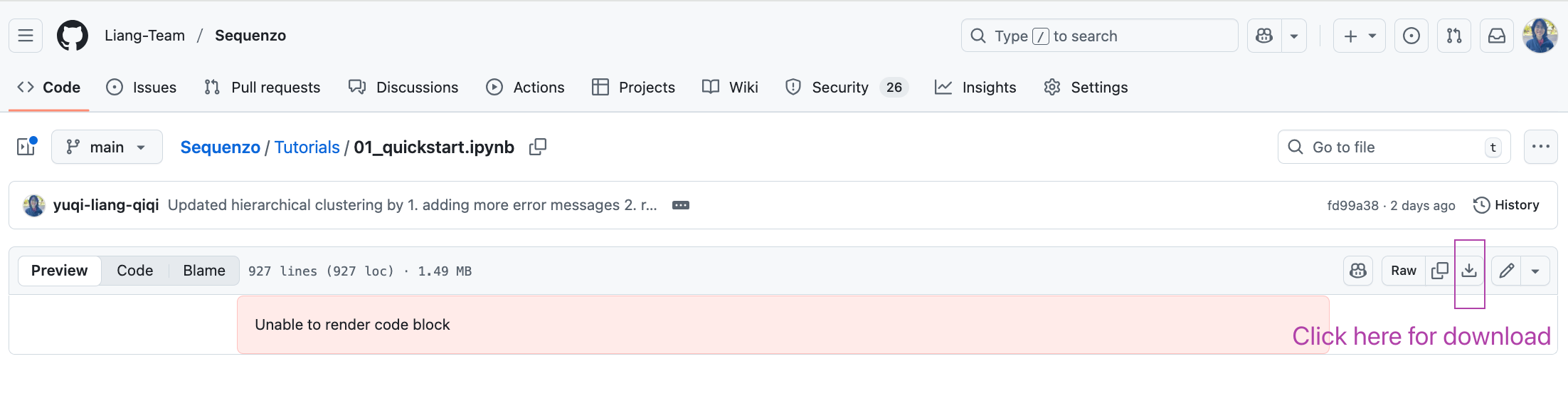
You can also view our tutorials on GitHub, but its preview sometimes fails for larger Jupyter notebooks; examples of these rendering issues are shown at the end of this page. To download any tutorial, open it on GitHub and choose the down-arrow icon (top-right menu) to save the file locally.
Recommended: Open in Colab
Click the "Open" link in the "Open in Colab" column of the following tables to immediately run, edit, and save a copy to your Google Drive.
Notebooks (Open in Colab)
Getting Started
| Notebook | Description | Open in Colab | View on GitHub |
|---|---|---|---|
| Quickstart | Install, load data, and run your first analysis. | Open | Source |
| Local vs. Global Quintiles | Compare local vs global binning for value-to-state mapping. | Open | Source |
Dissimilarity & Clustering
| Notebook | Description | Open in Colab | View on GitHub |
|---|---|---|---|
| Dissimilarity Measures | Compute and compare sequence dissimilarity metrics. | Open | Source |
| Clustering: Hierarchical vs. PAM | Compare Ward's method and PAM on the same data, evaluate agreement and cluster quality. | Open | Source |
Multi-Domain Sequence Analysis
| Notebook | Description | Open in Colab | View on GitHub |
|---|---|---|---|
| Multidomain Sequence Analysis | End-to-end analysis across multiple domains per subject. | Open | Source |
| Polyadic Sequence Analysis | Analyze polyadic sequences (multi-actor interactions). | Open | Source |
| Multidomain Sequence Analysis: CombT | Python script (.py) for a CombT analysis workflow on multidomain sequences. | Open | Source |
| Polyadic Sequence Analysis: Script | Python script (.py) version of the polyadic analysis workflow. | Open | Source |
Hidden Markov Models
| Notebook | Description | Open in Colab | View on GitHub |
|---|---|---|---|
| HMM & Mixture HMM (mvad) | Identify hidden life stages and cluster trajectory types in school-to-work transitions. | Open | Source |
| HMM (pairfam) | Fit a hidden Markov model to family and activity trajectories from pairfam. | Open | Source |
| Multichannel HMM (biofam) | Model marriage, parenthood, and residence as parallel channels in a joint HMM. | Open | Source |
| Non-Homogeneous HMM (pairfam) | Incorporate covariates that affect transition probabilities with NHMM. | Open | Source |
Why GitHub preview may fail
Sometimes GitHub fails to render a notebook (.ipynb) and shows:
Unable to render code blockYou might see a screen like this:
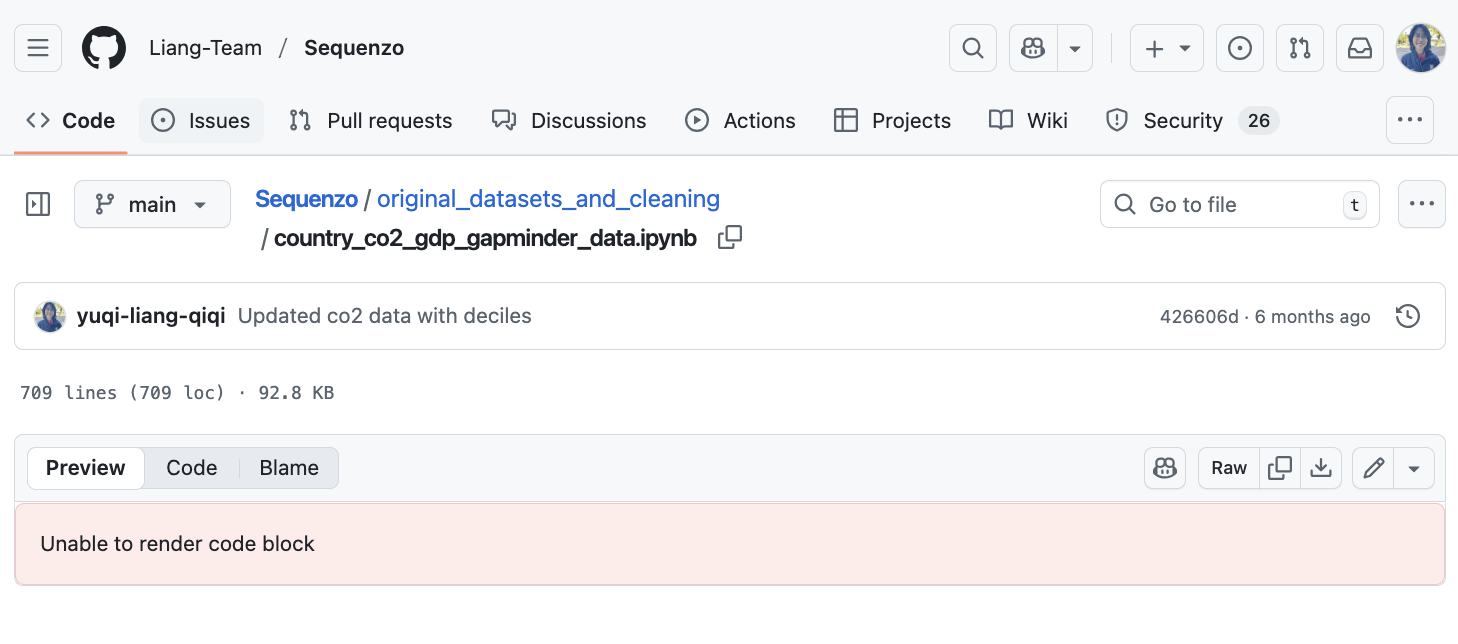
This is a known limitation of GitHub’s preview for large outputs or complex notebooks.
To download the tutorial, click here:
Author: Yuqi Liang; Yapeng Wei